Pages

Showing posts with label Games. Show all posts

Monday, October 11, 2010

Singularity - Nostalgia at its worst and best


The mighty FPS (First-person shooter) has been the staple of the ever hungry nerd since the spawning of his existence from the primordial soup eons ago. We all know the FPS genre has gone through a few changes with the evolution of physics in Half-Life, the blood and gore of Quake and Doom, and even the progression of storyline in the likes of Bioshock, Fall Out 3 (more so an FPS-RPG hybrid) and even Call of Duty: Modern Warfare 2 with its cinematic beauty and Hollywood styled fast-paced action. Bioshock was a noteworthy achievement in the history of the FPS, not so much as Half-Life which deserves even more credit, but nonetheless it furthered story elements, plot and issues of morality beyond any of its predecessors. Following Half-Life and Bioshock FPS games have continued along this trend adding moral weight and relying heavily on story to support a game through and through. Recently, with the release of the game Singularity developed by Raven Software, who previously worked with id Software on Quake 4, the nostalgia of the genre as a whole is realised.

When you first begin the game you soon come to realise the striking similarities between Singularity and Bioshock. It’s almost as if minimal game development took place, and Raven Software were off drinking coffee, playing some Modern Warfare 2, ate some day old ramen noodles then realised they were game developers. In essence they’ve produced a lacklustre ‘Borat’ of a game, which as this review will explain, lacks a cohesive story and relies too heavily on repetitive gameplay. In Singularity you play as Renko, a member of an American reconnaissance team, who is investigating the island called Kartorga-12. On the island a catastrophe occurred involving the Element 99 leading to the formation of a ‘singularity’ causing a nuclear fall out, which mutated much of the island’s inhabitants. As the player progresses in the game it becomes apparent that the Soviet Union was pulling a fast one, covering up the horrific experiments they conducted on the island. The result is a variety of Element 99-powered monsters with abilities ranging from teleportation to super human strength. But, don’t worry of course you have some firepower on your side and the TMD (Time Manipulation Device) which gives you mastery of time in all of its glory. With the TMD you can age enemies to dust, move objects backwards and forwards in time and shoot opponents with bursts of time-force killing them in the process. This becomes handy when faced with puzzles and the barrage of enemies you encounter as you travel through the game.


Puzzles are much the same throughout the game, with the simplicity of having to age an object to reveal a new path to moving objects and using them to overcome obstacles. There are a few moments where admittedly the monotony is broken, such as one level where you have to rebuild a whole ship and steal a nuclear war-head, but these are far and few between. The experience ends up in a vice grip with moments of utter bemusement (there are some really WTF moments) to seriously dreary segments where a game of ‘Rock Paper Scissors’ is more invigorating. It’s not that the game is terrible it just lacks a certain spark that other FPS games pull off so well. The reality is most games in the genre end up recycling ideas, this is inevitable, but they do so with some style and add a new dimension of experience. The development team of Singularity tried to take the best bits of the genre and re-package it to eager nerds, expecting us to lap it up like some deranged WOW addict. Singularity is a good attempt but misses the mark entirely. One of the redeeming qualities of the game, ironically, can be found in its weaponry. In terms of weapons Singularity has a lot more going, however that is only in certain instances. The Seeker is one such weapon (a sniper rifle of sorts) with the exception that when shot the player can control the path of the bullet weaving through enemies hitting vital spots dead-on. This is extremely useful (and bad-ass) when in the middle of a gun fight, and enemies are scattered all around the map. Other weapons are pretty standard with a revolver, assault rifle, Spikeshot (a special railgun which can charge its energy and when released ploughs through enemies), Autocannon (a frickin’ huge mother of a machine gun), a grenade launcher, a normal sniper rifle and finally a rocket launcher.
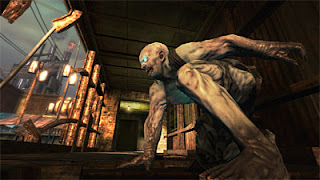

There is no true effort to innovate, with the exclusion of the Seeker and Spikeshot and this extends to the story and the characters that reek of cheese. Renko has no moral urgency and is cardboard-cutout who has no core to his character, yet all we know is he’s American, apparently got some skill and kicks ass like nobody’s business. The only time morality came into the fray was right at the end of the game, and by then you tire of the experience altogether. There’s no true substance to Singularity and by the same accord it doesn’t foster any emotional ties with Renko or the other various characters. Bioshock, and even Half-Life made you feel for the characters, enter their worlds, their experiences. Singularity hardly tries to bring the player into the world of Kartoga-12 let alone uncover Renko’s motivations and feelings of his whole ordeal.

Graphically, Singularity is a beauty to behold utilising the Unreal 3 engine in all its full glory. Everything flows naturally in-game like a well oiled AK-47 in motion firing rapid-fire in a fit of lunacy. Models are highly detailed and the monsters are somewhat non-threatening, offering little of what other horror games achieve on a visual level. Singularity visually brought the world of Kartoga-12 (in all its deformed beauty to life). Yet, at times it felt as if Singularity was more dependent on the graphical side of things, rather than developing a more intriguing plot and storyline.

Now you’re probably wondering how can Singularity be compared to Bioshock, is this dude on crack or something, or has this guy got a few screws running loose. God knows, but Singularity in its design and the way it pans out attempts to be what Bioshock was, with a design approach that is eerily close to said game. Everything down to the voice recordings and 50s styling is all so similar, except for the game being set on dry land and your fight in this instance is against a deranged Soviet dictator. Gameplay involving the TMD is just a substitute for the plasmids from Bioshock which offered more in terms of the powers you could use. In Singularity the variety of time powers is limited, and at times feels like it could have been more fully utilised for its potential. Singularity is also lacking in the story department and ends up being s half-hearted attempt of trying to horrify the player, and doesn’t effectively create tension. On the other hand a game like Metro 2033 achieves tension effortlessly and (albeit more successfully) than Singularity, with the extended periods of silence and sudden scares that come at you out of nowhere. At the end of it all Singularity is so-so and doesn’t do anything new within the genre. Its reminiscent of old-school shoot-em’ up violence, and if that’s what you’re looking for go ahead and buy it. However, the game suffers from flat characters and a cheesy story which leaves Singularity sorely predictable. Time could be more well spent playing a game like Borderlands (with its extensive DLC) if you’re tiring of the whole ‘time travel’ thing.

Singularity is average at best and offers nothing new ending up as a big disappointment with loads of lost potential.

Tuesday, July 27, 2010

Low on Macro, Large on Fun, Supreme Commander 2

Assuming you’re not a genius of some sort, imagine the difficulty of trying to solve a Rubik’s cube in one sitting. That’s still not quite enough for the sake of this comparison; so at the same time, try cooking a three course meal, knitting and playing the piano all while still trying to solve that Rubik’s cube. I think that about accurately describes the macro and micro required to effectively play the original Supreme Commander. So, and giving that my logic is on occasion correct, it’s not unreasonable to assume that when ‘Gas Powered Games’ release a sequel. We can be expected to have to employ much of the same insane management skills as before. However, and quite predictably, ‘Supreme Commander 2’ is a little bit different. This happens because somewhere along the line and in the midst of all the young and strapping (new age) multi-genre games. The RTS genre, being relatively old in the world of gaming has decided it appropriate to have a midlife crisis, buy a sports car and get a new hair style. I say predictably because this ‘RTS evolution’ has been happening since as early as Warcraft 3, but more recently Dawn of War 2 and even Command and Conquer 4 has followed suit. As an intrepid nerd I respect the idea of gaming innovation and evolution. It’s when it comes to the implementation of this idea upon an already popular franchise that I feel the need to be critical. This being particularly true when it involves the adaptation (or possible mutilation) of an already working and well received formula. Happily, Supreme Commander 2 got the haircut but hasn’t bought the sports car; and so has maintained a balance of old and new with much of its RTS character remaining intact.

Gas Powered Games, having obviously been influenced by their project partners (and RPG gurus) Square Enix; have taken a more tactical and ever so slight RPG’ish approach to Supreme Commander 2. The original game implemented a tier unit and construction system to which higher tiered units were vastly more powerful than their lower tiered brethren; meaning any relatively experienced player who was able to climb the tiers fast enough would absolutely crush all opposition. To alleviate this, the developers swapped the tier system for a more docile research tech tree; whereby the player is tasked with collecting and using research points to upgrade their armies on the fly. This means that should any player find themselves backed into a strategic corner; they’d have the opportunity to research their way out. Unfortunately as a side-effect of this system, some strategic depth has been lost. The tech tree system also seems to encourage research point amassing and uber turtling, not that that’s any less fun for most
gamers. Another (welcome) change comes from that of the experimental units. In Supreme Commander 1, experimental units were potential game ending units that possessed nothing less that grandiose fire power; but took monumental resources, time and effort in order to construct and invoke their mighty wrath. Supreme Commander 2 has become a race to build the most, now much cheaper and just as pleasurable, sexperimental (I mean experimental) units as possible before your opponent does so first.

Supreme Commander 2 seems to favour the casual rather than the alienating them as the original did. The more elite RTS fan will unfortunately most likely find it lacking in depth. Whether you agree with this new take on the franchise or not it is a solid game; and what it now lacks in depth it most certainly makes up for in fun. The campaign although repetitive in places was enjoyable and serves as a great introduction to the multiplayer side of the game, the real meat and potatoes. Multiplayer is as awesome as many will have expected. The balance and variety of unit make for both expected and unexpected strategies. Even when it comes down to experimental rushes, a good experimental strategy and mix will always overcome a straight attack.

Supreme Commander 2 is entertaining and could easily replace the hole Command and Conquer 4 has left behind; well at least until Star Craft 2 is (if ever) released. The graphics engine provides brilliant detail with a negligible cost on performance. I’m also happy to report there are comparatively few bugs. As a consequence of Supreme Commander 2’s midlife crisis, fanboys of the original and its epic RTS style will most likely be found frothing at the mouth when Supreme Commander 2 is brought up in conversation. For everyone else and despite its need for a rather large patch if you want to play online, it really is an enjoyable RTS that any fan of the genre can enjoy.

Experimentals FTW! green_FIEND

Tuesday, June 15, 2010

Just Cause 2 - where a grappling hook and parachute is all you need!


Remember the days when games were about gameplay, shooting enemies in a frenzy of violence, achieving that fatality after a hard battle in Mortal Kombat and dismembering hordes of zombies with a chainsaw. Avalanche Studios and Eidos the developers behind the original Just Cause have recognised this long hallowed tradition and came to the table with Just Cause 2. It’s a brutal departure from the mundane experience of the first game with high-octane stunts and gravity defying physics. From the outset, it is made clear the game isn’t focused on plot. Rather, gameplay is king and Just Cause 2 marries Chuck Norris fighting technique with the execution of a James Bond film. Shooting itself up with a few injections of adrenaline like jumping face first out of a plane at high altitude. Just Cause 2 is both a pleasure and an irritation.


The game’s storyline resembles a B-grade action movie and appears at first glance to be the oh-so predictable espionage tale of intrigue and big explosions. Just Cause 2 is set in the expansive South-East Asian island of Panau which is run in a similar vein to Cold War era Cuba, mixed with a bit of North Korean flair. You play as Rico Rodriquez an agent working for the shadowy US organisation “the Agency” and your mission is to eliminate the fascist regime of Baby Panay. The game follows the typical route of many of its sandbox predecessors, where players have a huge world map to explore (in the case of Just Cause 2 it’s epicly huge) and complete various missions. These missions are plentiful and the game itself works on the basis that the player needs to create chaos in order to increase the mission roster. With the insane arsenal of upgradeable weapons for purchase, not to mention vehicles, achieving chaotic bliss is no difficult chore and once you amass enough chaos various missions become available. Missions are divided between faction missions and agency missions, but first you have to choose one of the many factions.

Three main factions exist: the Roaches led by a corrupt businessman, the Reapers (definitely Che Guevara fans) and finally the Ular Boys led by a religious revolutionary reminiscent of the ever popular Osama Bin Laden. Faction missions follow the very simple formula of destroy, destroy, blow up stuff, destroy, save a hostage, destroy and destroy some more. The same can be said of the agency missions, which becomes repetitive as the game progresses. For the most part this is quite entertaining but can drag on after an intensely long gaming session. The reality is that Just Cause 2 is a game best played when either boredom sets in or time is not a factor. This doesn’t mean Just Cause 2 is a bad experience. Actually, it’s quite enjoyable and excessively fun until you have to travel from one side of the world map to the other searching for a mission trigger. In the game fighting increases the alertness of enemies (similar to wanted levels in GTA) and the more chaos you cause the higher the alert level. So be wary because if you’re alert level reaches critical you’ll be bombarded with missiles from every corner and the Panauan army will surface. But, if you have the skills you may survive, and fighting is at the heart of Just Cause 2’s game mechanic. The game is about duking it out with enemies and this is where the absurd charm of Just Cause 2 begins to shine.


Gameplay for the most part centers around a system relying on Rico’s dual grappling hook and his never-ending supply of parachutes. Pair this with a barrage of upgradeable weaponry and vehicles obtainable by gathering ‘parts’ and you become a lethal combination that leaves enemies incapacitated. The player can find a million ways to kill enemies, employing only the dynamics of the grappling hook and surrounding environment. In my own dabbling in-game I found attaching enemies to burstable gasoline cylinders quite enjoyable, with the enemy shooting straight up into the atmosphere hurtling. The absurdity of the gameplay is taken to new heights in some of the missions. One mission involves the player having to destroy a rocket midair whilst flying a jet at break speed where death greets you at the slightest error. Just Cause 2 is really over-the-top and is enjoyable in short bursts and in the end the gameplay means the player can be as creative as they want. But, one of the main problems with the game is the mission roster which is infinite and in my opinion wasteful of playing time. Where the game could be more dynamic by varying mission types, it ends up repeating the same missions with different scenery. This again is why I suggest you don’t solely dedicate gaming time to Just Cause 2, because I see it more as a ‘filler’ between other games.


The extensive world map is relentless and completing the game fully is a quest in itself. There are quite a few villages and cities scattered across the terrain begging to be freed and players can let loose enjoying the pure mayhem, still after prolonged play this too becomes tiring. Ultimately Just Cause 2 is a game you’d play for the sake of gameplay and is really exciting while it lasts, but dries out soon enough. Some would argue that the storyline is where the game falters but I thoroughly enjoyed the camp-ness of it all ( the terrible voice acting included). It really brought out the cheesiness of those old spy films the game is mirroring. Most would overlook this title because of dated graphics, which I might add are not really an issue on the PC, whereas on the XBOX 360 version the quality of the graphics is supposedly abysmal.

Yet, what is concerning is that gamers nowadays are coaxed into games with high polygon counts and the gameplay mechanics of a chimpanzee with a joystick (Dark Void anyone). Whereas, Just Cause 2 is a game dedicated to gameplay and shouldn’t be overlooked because of dated graphics. It sets out to be a fun explosive thrill and achieves that, but lacks storytelling depth and variety in missons which would otherwise make it an utter hit with the majority of gamers. Just Cause 2 is a hit and miss, with wasted potential. RAMjew


Thursday, April 15, 2010

Rapture, There's No Place Like Home

For an allegedly flooded city at the bottom of the ocean and on the verge of collapse; the aptly named Rapture, seems to provide quite an accommodating home for its ‘unique’ citizens. And despite the fact that it’s on life support, in 2K Games’ Bioshock 2, Rapture’s environment is even livelier than what it was in the original Bioshock.

Not to be confused as a prequel; Bioshock 2 takes place eight years after the incidents of Bioshock 1. Andrew Ryan, being the ever so popular man that he was, had actually fostered two major enemies: Frank Fontaine a.k.a. Atlas, the plasmid whoring protagonist of the first game, and now Sofia Lamb, a psychiatrist way past her sell by date. This being Bioshock, we expect our antagonistic villains to meet the strict standards of crazy and power hungry to which we hold. Luckily for us, Sofia Lamb does that by bucket load.

The premise behind Bioshock 2 is simple, 2k Games, having recognised our urge to kick some serious ass from behind the visor of a Big Daddy suit. Lashes us (the player) into a prototype Big Daddy suit, names us Delta, and sends us on our merry way. As with any Big Daddy, our purpose revolves around the protection of the Little Sisters. But unlike any other Big Daddy, and owing to our prototype nature, we are paired with but one Little Sister named Eleanor. Unfortunately for us, and as is the nature of things, Eleanor just so happens to be the daughter of Rapture’s most popular resident psychotic, Sofia Lamb. This is introduced to us, in part, by an introductory cut scene, which according to Bioshock 2’s time scale occurs ten years before the start of the game and so two years before the start of Bioshock 1. Eleanor is captured against her will by Sofia and her goons, who through the use of those pesky plasmids, manipulates Delta into committing suicide. It’s ten years later and Eleanor, now all grown up, and along with the other Little Sisters of Rapture, want to be free of both Sofia and her monologue inducing plot. The game begins with the revival of Delta, after which, Eleanor requests the player to free her from her imprisonment. Ruining the plot or diluting the story wouldn’t give the game justice. So briefly, the game involves Delta’s trials in the attempt to find and rescue Eleanor, and tribulations in stopping Sofia’s plans.

In order for this plot to succeed, and as is done in the first game, the atmosphere of Rapture is really quite involved. It’s just as easy to get lost in the dystopian and steam punk lore of Rapture as it was in the original game, where the architecture and environment truly embrace the magnitude and achievement of something like Rapture. The numerously placed audio logs are also back, and this time in greater number. These serve to both introduce and carry a large portion of Rapture and its inhabitant’s story forward. Sadly the ocean views may get repetitive at times, and many of the areas seem to be more linear than the original game. But the level at which the characters and surrounding world interact and persuade us to believe all that we encounter, is easily of the same standard and if not better than the first game.

Being a prototype Big Daddy does explain why Delta is able to wield plasmids. Why a prototype is faster, stronger and smarter than the final version however, is beyond me. That being said, it shouldn’t really matter how Delta kicks ass; because if there’s but one universal truth to gaming, it’s that it’s fun to kick ass. Not being content with a simple rehash of the originals game mechanics. Enough change and improvement has been made to keep the combat, Adam collection and hacking mechanics of Bioshock 2 enjoyable. The combat has a faster pace, sometimes elevating to large scale showdowns and gunfights. Hacking is thankfully more intuitive and less interruptive, with the new hacking mini-game, the player must hack on the fly and so isn’t removed from the experience. Trying to hack an object while attempting to dodge incoming fire can be a lot of fun. Adam collection still sees us defeating our fellow Big Daddy brethren, the difference being that instead of simply choosing whether to harvest or save each individual Little Sister; the player can now choose to temporarily adopt the Little Sister. After doing so, we must subsequently locate and protect specific corpses, to which our Little Sister happily consumes their blood, mmm tasty. The benefit of protecting her from those maniacal splicers is a greater Adam return when we finally decide the fate of each Little Sister. These choices both shape the ending of the game and trigger a Big Sister to attack after saving or harvesting all available Little Sisters in a stage. Big Sisters are grown up Little Sister under the persuasion of Sofia Lamb; so prepare yourself for a fight, because apart from wielding almost every plasmid and some serious weaponry, they provide enough of a challenge to lay down some serious hurt. Being a Big Daddy, we come fully equipped and adorned with a bunch of neat trinkets; like the bolt friendly rivet gun, and the always satisfying and always effective giant drill.

Bioshock 2, just like the original Bioshock, is definitely a game worth playing. And while graphics addicts may have gripes with the visuals not being as smooth or the water as clear as its original, there is certainly a whole lot more animation going on. Besides, it was never trying to win any medals for its graphics. And bugs aside, its real strength is in its detail; characters portray a lot more emotion than the cardboard cut outs of most; and at times, its atmosphere can be audio and visual bliss. The game attempts to captivate and hold your attention from start to end, and to this endeavour, it does it brilliantly.

It isn’t perfect, but it’s a great reason for us to visit Rapture again; and that’s all we ever wanted. gr33n_FIEND

Friday, March 19, 2010

Borderlands: where ownage is the aim


A dust storm settles as you prepare to take flight into the life threatening world of Pandora. It is you, your gun against a mass of enemies who will make your life a living hell. Borderlands is not a game for the faint of heart, because around every turn are surprises (some funny and others outright awesome). These can be mutated dogs called Skags to bandits who are really a bunch of intergalactic hillbillies. On the planet of Pandora you either go with the flow or against it. Playing the game I experienced a gut wrenching over the top ride bursting at the core with enough excitement for any hardcore gamer. So get ready for a serving of pure unfiltered action, and a few tranquilisers for the shock of awesome that is about to enter your system.

Borderlands was engineered by Gearbox software who are so epic that their first try at a original game is pure win. The game harnesses mystical powers combining first person shooter style, with the grace and depth of an RPG (roleplaying game). This means you can haul ass with huge weapons, and gather loot like theres no tomorrow. You have the choice of picking four different characters: Brick the berserker with strong melee abilities, Lilith with a phasewalk ability meaning she can teleport. There is Mordecai a bounty hunter specializing in sniper rifles and pistols, with his pet Bloodwing (who kicks major ass). A final choice is the mercenary Roland who is great for close combat and is able to deploy a turret that mows down enemies like a lawnmower in a field of zombies.


The story of Borderlands begins with the discovery of the Vault on Pandora, which opens up every 200 years. This is where your character kicks butt and depending on who you choose, the game plays out differently. But, the essential goal is finding the Vault and opening it with vault keys scattered across Pandora. It is rumoured to have alien technology and vast amounts of loot enticing many from across the galaxy to take their chances, and become Vault Hunters. The story is simple and is not over complicated. But the experience for me was full to the max with ownage. Borderlands is a joyride in a nuclear-powered scooter with no brake and a steep hill ahead. With that being said the game mechanics involves first person shooter action alla Unreal Tournament, meaning violent and oh so sweet headshots. It is then mixed with a dash of Diabol-esque item hording, leaving you with a smile of glee as your pillage whats left of your enemies.


The graphics are in no way jaw-dropping but are stylized and cell shaded, giving off a cartoon feel so fresh in a market where games aim for realism. This goes well with the bloody violence and roster of missions including: bounties, scavenger hunts, car races which bring the game up a few notches on the belt of godly gaming. The music was nothing to write home about (even from a galactic outpost on the far edges of the galaxy). But, in all honesty Borderlands is a real gem from Gearbox and has miniscule faults. It’s available on: XBOX 360, PC and PlayStation 3. Now, get those arms flexed and ready to enter Borderlands where the badass are really badass.


The game gets 85% and an approval of awesomeness from me. RAMjew

Thursday, February 4, 2010

Born to be a rebel? Red Faction Needs you!


You know I have this theory that rebels must have a hard time. This thesis of sorts was confirmed whilst playing the awesome game Red Faction Guerilla. Where, oddly enough you are a rebel and the main objective is to blow stuff up. The player faces the evil actions of the Earth Defense Force (EDF) who plan to terraform Mars to hell and gone. You take on the role of Alec Mason, a mining engineer who seeks revenge for the death of his brother. Red Faction Guerilla is a third person shooter, sandbox game by developer, Volition. Volition well known for their previous Red Faction games mix up the gameplay and borrow heavily from other sandbox games. This in itself is not a bad thing as it takes the best elements of GTA, Prototype and even Assassin’s Creed. The player is faced with the daunting task of taking back control of Mars from the EDF. Mars itself is divided into different sectors in which the player has to lower the control of the EDF, by blowing stuff up and completing missions. Different EDF facilities are rated in order of importance, meaning if you take out a high importance target more control will be lost. Missions range from demolition, to transporting vehicles and even guerilla raids on the enemy.

The fun of the game is in completing these missions which raise the morale of the people in a sector. As the morale increases ordinary civilians begin to join the guerilla movement, and support you in your fight against the EDF. What, also makes the game unique is the freedom it allows you to achieve a mission objective. For example if you wanted to blow up a target you could set up mines, destroy it with large vehicles or even rocket launch it to hell. This ease of choice means there are endless possibilities. The storyline is intriguing with the continuous plotting of the EDF, the unknown goals of the marauders and the story of a man seeking revenge.

Red Faction Guerilla has excellent graphics, but has some lag issues which may depend on the specs of your rig. The game offers something different in the overcrowded sandbox genre, improving on some of it’s borrowed gameplay elements. Overall, the game will satisfy any gamer with a taste for destruction and mayhem.

84% A great game, let the destruction begin. RAMjew

Monday, October 12, 2009

Pollen on the Brain (A Plants vs. Zombies Review)

Unfortunately in the world of gaming, the recycling of old and unoriginal gaming ideas is a viable and highly profitable business. It’s not often that a developer like Pop Cap (being the kings of recycling themselves) makes something new, yes they create newer games, but those games are basically re-skinned versions of their older ones and as such, are not really new in a sense. But winds of change seem to be blowing, because unbelievably, they made not only a new game, but one that involved every gamer’s favourite mascot, the zombie. Naturally, I was quite excited, although I must admit I still had my reservations; once I had played the game however, those reservations quickly became null and void as I found myself playing an incredibly fun game.

Plants vs. Zombies is basic in its formula but very big in its result. By taking influences from the tower defence maps of Warcraft 3, and building upon that simple premise, the player must prevent zombies from munching on the brains (which they oh so lovingly do) of the houses owner. It’s simple yet deceptively fun. Zombies, being the nuisance they are, spawn in continuous waves on the right side of a garden, their goal, is simply to get to the left side where the owners house is located. Your job as the player is to strategically place plants in an effort to prevent the zombies from accomplishing their goal; which as you would expect, becomes progressively more difficult each level. In order to successfully defend your garden, and through the various methods available to you, the player must collect enough sun power with which you can plant your vegetable army. How these photo synthesisers of doom manage to impede such zombie masses? Well I’m not exactly sure, but what I do know, is that by acting as either defensive obstacles or offensive attackers, they get the job done with satisfying effect.

These satisfying ingredients make up a majority of the game, but between every few levels, and after completing the game however, a series of enjoyable mini-games present themselves. These mini-games allow for a variation of play styles, this successfully manages to keep the game fresh and fun; ranging from the bowling over of zombies with walnuts, to playing a bejewelled style game with a twist.


As important as gameplay may be, there are many other elements to which comprise a game. For example, both the graphical style and audio track lend themselves brilliantly to the game and its accommodating themes. In fact, they do more than that, because they help to complete the game. Without these specific design choices, the game would seem less like a retail product and more like a mini browsing game. Over and above everything else I have mentioned, it’s the polish that most astounds me. The game is well balanced, almost completely bug free and not to mention incredibly addictive. Not only has Plants vs. Zombies been polished to an absolute T, but the game reeks of character, to a point you’d think it was the stilton of gaming. So what am I trying to say? Well it’s quite simple really, play Plants vs. Zombies. It really is a fine game, and if anything to go by, I see better days to come from Pop Cap.

It's a great game, its only real failing is its short length. gr33n_FIEND


Tuesday, September 1, 2009

X-Blades... It's a shame really :(

Elite, noob or casual, no matter the gamer, no matter the age, if I were to ask the simple question, what would you get if you mixed ‘Devil May Cry’ with ‘Serious Sam’? Without a shadow of doubt, the answer would be one of two things; a short and approving “epic” or a freakishly high pitched scream of joy. Unfortunately, when it comes to the game X-Blades, the saying “Don’t judge a book by its cover” comes to mind. X-Blades was developed by Gaijin Entertainment and published by both South Peak Interactive and Top Ware Interactive. It starts with its good foot first, but it must’ve stubbed its toe on the way in because the game not only starts to make a distinct growling noise, but seems to refuse to allow the player have almost any fun at all.

Sure it has some nifty cel-shaded graphics, it also closely resembles the anime look it was so obviously inspired by. But like the many games before it and almost certainly the games to follow, graphics will never be the be all and end all of a game. I should probably tell you a little about it, it’s a hack and slash adventure game; the player assumes the role of Ayumi, a sword wielding, gun slinging Dante wanabe. Her fighting style is very similar in essence to Dante’s (the lead character of Devil May Cry), while Dante has an absolutely absurd amount melee and ranged attacks, enough in fact to put even Kratos to shame. Ayumi has the same repetitive melee and ranged attack throughout the entire game. She can also gain a variety of new abilities, this is achieved by collecting souls found within each of the levels, the player does this by both attacking and defeating the many enemies, and/or collecting soul pieces placed throughout each level. When it comes to fighting these so called enemies however, it is an endeavour similar to that of a Serious Sam game; in each level there is a succession of progress blockers, once the player reaches these areas, a series of fixed generic monsters and monster generators spawn in, in order to proceed the player must defeat all of these opponents. Unfortunately for the player, the monsters seem to be nothing but re-skinned, recycled and atrociously dim A.I.

Things aren’t going great for X-Blades are they. I’m not going to beat around the bush, the screenshots of X-Blades sold me, and I really did believe I would enjoy it. The problem with the game is not its founding idea, that’s solid and settled. But its severe lack of polish in areas like; delayed movement controls, repetitive game play mechanics, abilities that add almost no advantage to combat and a tiresome soundtrack. The story just has no motivation behind it; its gaping plot holes, failure in tying levels together and poor dialogue they all pull away at the games core. Endless as this list may be, I wouldn’t give in so easily and was determined to finish it. No game should be this hard to enjoy, it just isn’t any fun for any extended amount of time. And when you consider the amount we pay for games nowadays, any charm or potential this game originally had, quickly and regrettably became obsolete.
Im sorry to say, but it gets a lowly score from me. gr33n_FIEND