Pages

Monday, August 2, 2010

Star Gate Universe, Redescribing My Favourites

Among the drones of the nerd collective, I fly the banner as a digital legionnaire. Gaming, star ships, dragons and hell of a lot of coffee; these are the things I pledge an allegiance to. As a nerd, there’s nothing more blissfully satisfying than sniffing a variable digital coke off of an electronic toilet seat (so to speak). Although, and despite relinquishing most of my soul to a life of visual and audible servitude; I have made the best of efforts and intentions to avoid fanboyism at all costs. Nothing is worse than when an intelligent debate of Star Wars vs. Star Trek or Cloud vs. Sephiroth is mangled by an angry fanboy flaming the forum. In trying to avoid the ruthless path of a fanboy, I have dedicated myself to keeping an open mind to both clones and sequels of my favourite franchises. In the spirit of extending myself, I am going to give Star Gate Universe a shot.

You’ve finally figured out what this article is about; I like, love, cherish (need more synonyms), adore, admire, respect, and value (there that should be enough) Stargate. It’s the novelty and quirkiness in combination with a deep and engrossing sci-fi lore that commands nothing but love for the series. Both ‘SG1’ and ‘Atlantis’ appreciate the need for an appreciably serious plot, yet preserve a balance with witty characters and a light (sometimes comedic) atmosphere. So when a darker, more serious Stargate ‘Universe’ takes the stage; an urge to show my Hyde or Hulk side began to emerge. The only way to stop it is to shut up, watch some episodes and give my first impressions.

I began the first episode with some seriously negative expectations; while in retrospect, I should’ve had more faith in what I now believe to be a thoroughly enjoyable and gripping series. Stargate Universe primarily takes place aboard the Ancient built star ship known as ‘Destiny’. The lead characters, rather predictably, are the stranded aboard an ever journeying and slowing decaying Destiny. The series comprises of their current ‘day to day’ and past struggles. I say past because Stargate Universe has made a uniquely large attempt at defining and intelligently developing the major characters and their back stories. This, along with state of the art CG and cinematic techniques help it to break away from (of what some felt) a low budget feel of SG1 and Atlantis. That being said, Stargate Universe also comes packaged with the necessary increases in violence, blood and sex that all modern audience attracting series maintain.

As a diehard fan of SG1 and Atlantis I lament the loss of the series’ wit, character tone and flare. Everything being equal however, I really appreciate and enjoy this new series as a thing in itself and as a new take on former Stargate Tradition. It really seems to be the beginning of a great series. I can already see me being unable to wait patiently for each new episode.

As a sci-fi series I give it plenty of praise; it’s a shame it doesn’t quite feel like a Stargate series just quite yet. gr33n_FIEND

Tuesday, July 27, 2010

Low on Macro, Large on Fun, Supreme Commander 2

Assuming you’re not a genius of some sort, imagine the difficulty of trying to solve a Rubik’s cube in one sitting. That’s still not quite enough for the sake of this comparison; so at the same time, try cooking a three course meal, knitting and playing the piano all while still trying to solve that Rubik’s cube. I think that about accurately describes the macro and micro required to effectively play the original Supreme Commander. So, and giving that my logic is on occasion correct, it’s not unreasonable to assume that when ‘Gas Powered Games’ release a sequel. We can be expected to have to employ much of the same insane management skills as before. However, and quite predictably, ‘Supreme Commander 2’ is a little bit different. This happens because somewhere along the line and in the midst of all the young and strapping (new age) multi-genre games. The RTS genre, being relatively old in the world of gaming has decided it appropriate to have a midlife crisis, buy a sports car and get a new hair style. I say predictably because this ‘RTS evolution’ has been happening since as early as Warcraft 3, but more recently Dawn of War 2 and even Command and Conquer 4 has followed suit. As an intrepid nerd I respect the idea of gaming innovation and evolution. It’s when it comes to the implementation of this idea upon an already popular franchise that I feel the need to be critical. This being particularly true when it involves the adaptation (or possible mutilation) of an already working and well received formula. Happily, Supreme Commander 2 got the haircut but hasn’t bought the sports car; and so has maintained a balance of old and new with much of its RTS character remaining intact.

Gas Powered Games, having obviously been influenced by their project partners (and RPG gurus) Square Enix; have taken a more tactical and ever so slight RPG’ish approach to Supreme Commander 2. The original game implemented a tier unit and construction system to which higher tiered units were vastly more powerful than their lower tiered brethren; meaning any relatively experienced player who was able to climb the tiers fast enough would absolutely crush all opposition. To alleviate this, the developers swapped the tier system for a more docile research tech tree; whereby the player is tasked with collecting and using research points to upgrade their armies on the fly. This means that should any player find themselves backed into a strategic corner; they’d have the opportunity to research their way out. Unfortunately as a side-effect of this system, some strategic depth has been lost. The tech tree system also seems to encourage research point amassing and uber turtling, not that that’s any less fun for most
gamers. Another (welcome) change comes from that of the experimental units. In Supreme Commander 1, experimental units were potential game ending units that possessed nothing less that grandiose fire power; but took monumental resources, time and effort in order to construct and invoke their mighty wrath. Supreme Commander 2 has become a race to build the most, now much cheaper and just as pleasurable, sexperimental (I mean experimental) units as possible before your opponent does so first.

Supreme Commander 2 seems to favour the casual rather than the alienating them as the original did. The more elite RTS fan will unfortunately most likely find it lacking in depth. Whether you agree with this new take on the franchise or not it is a solid game; and what it now lacks in depth it most certainly makes up for in fun. The campaign although repetitive in places was enjoyable and serves as a great introduction to the multiplayer side of the game, the real meat and potatoes. Multiplayer is as awesome as many will have expected. The balance and variety of unit make for both expected and unexpected strategies. Even when it comes down to experimental rushes, a good experimental strategy and mix will always overcome a straight attack.

Supreme Commander 2 is entertaining and could easily replace the hole Command and Conquer 4 has left behind; well at least until Star Craft 2 is (if ever) released. The graphics engine provides brilliant detail with a negligible cost on performance. I’m also happy to report there are comparatively few bugs. As a consequence of Supreme Commander 2’s midlife crisis, fanboys of the original and its epic RTS style will most likely be found frothing at the mouth when Supreme Commander 2 is brought up in conversation. For everyone else and despite its need for a rather large patch if you want to play online, it really is an enjoyable RTS that any fan of the genre can enjoy.

Experimentals FTW! green_FIEND

Wednesday, July 7, 2010

Prince of Persia The Sands of Time: An adaptation not full of fail


Few game to film adaptations are successful and capable of earning a box office success, but the question is does Prince of Persia Sands of Time fare well? In recent years the rise of comic book movie adaptations has been popularised and every hero from the ‘goddamn’ Batman to the mighty (and drunk) Ironman have fallen prey to the Hollywood treatment. So, when the Prince of Persia franchise (beloved by hardcore gamers who would murder any director who bastardised their ‘baby’) was to be made into a film, heads turned and I found myself wondering the outcome of this whole fiasco. There have been many attempts at videogame adaptations with the Uwe Bol ‘classic’ Silent Hill (with only the badass-ness of Pyramid Head offering mild entertainment) to the Super Mario Bros. live action movie (with Dennis Hopper might I add) that flopped at the box office.        
 The Prince of Persia cast is spearheaded by well known actor, Jake Gyllenhaal looking the part for most of the high budget flick. Most fanboys would be raging at the Prince played by Gyllenhaal citing some minute difference between him and his videogame counterpart. The reality is that the videogames and film will differ as games execute story differently to films. Subsequently certain videogame elements may not bode well on film (this depends on the focus of a videogame) and in the case of Prince of Persia plenty of storyline exists. The central premise of a prince setting out to save a kingdom in dire need is carried well by Gyllenhaal, this juxtaposed against an entertaining performance by Ben Kingsley (a veteran of villains) provides a dynamic contrast between the pretty boy prince and vengeful uncle played by Kingsley. The result is a film that balances adventure, action and the occasional comedic moment to break the tension of the good versus evil narrative that drives much of the film. The added novelty of the Prince’s ability to rewind time(with the aid of a magical dagger) is intriguing, and wasn’t exploited fully in my opinion. The plot itself is one which has been overdone a million times in other countless adaptations of comics or videogames, and doesn’t mean the film loses out. The simplicity of a prince trying to save his kingdom and fighting off evil is a welcome effort and for me provided a great way to relax and not have to worry about complicated plot devices.          
 With the storyline of the videogame franchise so strong a foundation exists for director Mike Newell (director of Donnie Brasco, Mona Lise Smile and Harry Potter & The Goblet of Fire) to create a film that is faithful to the videogame trilogy and can peek the interest of moviegoers. The film merges elements from all three games revealing a Prince with depth and darkness as played by Gyllenhaal. The film prince can be comparable to other heroes harbouring self doubt such as Spiderman (played by Toby Maguire) with added awesome of Captain Jack Sparrow (played by Johnny Depp). ‘Awesome’ meaning the character holds an inexplicable charm, which I feel Gyllenhaal’s prince does more so than Toby Maguire’s Spiderman ever did. In all truth the Prince of Persia is a much better film than Spiderman 3 ever will be. The director Newell is not new to moviemaking and has an interesting body of work behind him making him a good choice for the director’s chair.    The film is an enjoyable ride with some standout performances by the supporting cast. 
 There were some memorable performances from the supporting cast with Alfred Molina as Sheik Amar utterly lulzworthy in his portrayal of an ostrich racing organiser, who conducts business in the desert to evade tax. However, Prince of Persia is still a Disney film and lacks any blood and gore due to a PG-13 rating. The film otherwise is faithful to the source material. It’s not a straight ‘by the book’ adaptation by any account yet it stays fresh using elements from the trilogy of games. The action sequences and camera work are on par with other Disney blockbusters, Pirates of the Caribbean most notably. It’s easy to see Disney hopes to create a new cash cow, which is highly unlikely. At the end of the day Prince of Persia works well as a mediocre action movie and a good night out at the movies. But, you wouldn’t be adding the Prince of Persia to your DVD or Bluray collection any time soon I reckon. 

Tuesday, June 15, 2010

Just Cause 2 - where a grappling hook and parachute is all you need!


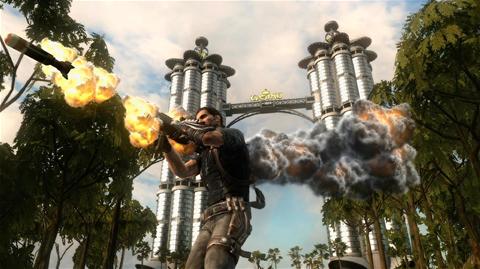
Remember the days when games were about gameplay, shooting enemies in a frenzy of violence, achieving that fatality after a hard battle in Mortal Kombat and dismembering hordes of zombies with a chainsaw. Avalanche Studios and Eidos the developers behind the original Just Cause have recognised this long hallowed tradition and came to the table with Just Cause 2. It’s a brutal departure from the mundane experience of the first game with high-octane stunts and gravity defying physics. From the outset, it is made clear the game isn’t focused on plot. Rather, gameplay is king and Just Cause 2 marries Chuck Norris fighting technique with the execution of a James Bond film. Shooting itself up with a few injections of adrenaline like jumping face first out of a plane at high altitude. Just Cause 2 is both a pleasure and an irritation.


The game’s storyline resembles a B-grade action movie and appears at first glance to be the oh-so predictable espionage tale of intrigue and big explosions. Just Cause 2 is set in the expansive South-East Asian island of Panau which is run in a similar vein to Cold War era Cuba, mixed with a bit of North Korean flair. You play as Rico Rodriquez an agent working for the shadowy US organisation “the Agency” and your mission is to eliminate the fascist regime of Baby Panay. The game follows the typical route of many of its sandbox predecessors, where players have a huge world map to explore (in the case of Just Cause 2 it’s epicly huge) and complete various missions. These missions are plentiful and the game itself works on the basis that the player needs to create chaos in order to increase the mission roster. With the insane arsenal of upgradeable weapons for purchase, not to mention vehicles, achieving chaotic bliss is no difficult chore and once you amass enough chaos various missions become available. Missions are divided between faction missions and agency missions, but first you have to choose one of the many factions.

Three main factions exist: the Roaches led by a corrupt businessman, the Reapers (definitely Che Guevara fans) and finally the Ular Boys led by a religious revolutionary reminiscent of the ever popular Osama Bin Laden. Faction missions follow the very simple formula of destroy, destroy, blow up stuff, destroy, save a hostage, destroy and destroy some more. The same can be said of the agency missions, which becomes repetitive as the game progresses. For the most part this is quite entertaining but can drag on after an intensely long gaming session. The reality is that Just Cause 2 is a game best played when either boredom sets in or time is not a factor. This doesn’t mean Just Cause 2 is a bad experience. Actually, it’s quite enjoyable and excessively fun until you have to travel from one side of the world map to the other searching for a mission trigger. In the game fighting increases the alertness of enemies (similar to wanted levels in GTA) and the more chaos you cause the higher the alert level. So be wary because if you’re alert level reaches critical you’ll be bombarded with missiles from every corner and the Panauan army will surface. But, if you have the skills you may survive, and fighting is at the heart of Just Cause 2’s game mechanic. The game is about duking it out with enemies and this is where the absurd charm of Just Cause 2 begins to shine.


Gameplay for the most part centers around a system relying on Rico’s dual grappling hook and his never-ending supply of parachutes. Pair this with a barrage of upgradeable weaponry and vehicles obtainable by gathering ‘parts’ and you become a lethal combination that leaves enemies incapacitated. The player can find a million ways to kill enemies, employing only the dynamics of the grappling hook and surrounding environment. In my own dabbling in-game I found attaching enemies to burstable gasoline cylinders quite enjoyable, with the enemy shooting straight up into the atmosphere hurtling. The absurdity of the gameplay is taken to new heights in some of the missions. One mission involves the player having to destroy a rocket midair whilst flying a jet at break speed where death greets you at the slightest error. Just Cause 2 is really over-the-top and is enjoyable in short bursts and in the end the gameplay means the player can be as creative as they want. But, one of the main problems with the game is the mission roster which is infinite and in my opinion wasteful of playing time. Where the game could be more dynamic by varying mission types, it ends up repeating the same missions with different scenery. This again is why I suggest you don’t solely dedicate gaming time to Just Cause 2, because I see it more as a ‘filler’ between other games.


The extensive world map is relentless and completing the game fully is a quest in itself. There are quite a few villages and cities scattered across the terrain begging to be freed and players can let loose enjoying the pure mayhem, still after prolonged play this too becomes tiring. Ultimately Just Cause 2 is a game you’d play for the sake of gameplay and is really exciting while it lasts, but dries out soon enough. Some would argue that the storyline is where the game falters but I thoroughly enjoyed the camp-ness of it all ( the terrible voice acting included). It really brought out the cheesiness of those old spy films the game is mirroring. Most would overlook this title because of dated graphics, which I might add are not really an issue on the PC, whereas on the XBOX 360 version the quality of the graphics is supposedly abysmal.

Yet, what is concerning is that gamers nowadays are coaxed into games with high polygon counts and the gameplay mechanics of a chimpanzee with a joystick (Dark Void anyone). Whereas, Just Cause 2 is a game dedicated to gameplay and shouldn’t be overlooked because of dated graphics. It sets out to be a fun explosive thrill and achieves that, but lacks storytelling depth and variety in missons which would otherwise make it an utter hit with the majority of gamers. Just Cause 2 is a hit and miss, with wasted potential. RAMjew


Thursday, May 13, 2010

Iron Man's number two


Just this week I was asked by a friend the most deep and intellectual question, ever possible. It was so amazing and shocking that I remained in a state of silence for a few seconds, before swiftly in my mind visualising possibilities. The question, simply put by the oh so clever individual, was, "Hey, how do you think Iron Man takes a dump flying around in his suit?". The question was so groundbreaking I considered my options, and the possibilities of how Iron Man could take a 'number two' materialised in front of my very eyes.


Some of the choices were so incredible I just had to share them with you.

Here they are in no particular order:

  1. Iron Man shares the same excrement disposal system that airplanes use where planes ascend to high altitudes and said excrement becomes frozen, and is released into the ocean below.
  2. Iron Man has a unique fossil fuel generator integrated into his suit so when he decides to let the ‘spaceship’ loose, it is converted into a viable fossil fuel (in comparison to something like coal).
  3. Iron Man has a missile guidance system situated near his rear that shoots out special skudmark missiles made of a combination of faecal matter and high explosives.
  4. Finally, Iron Man simply has a release latch so that whenever he feels nature calling, he simply opens the hatch and lets loose like a pigeon midair.


These are all possibilities, and some could be the truth. Or, maybe Iron Man has a strong case of constipation and is in need of some laxatives. Better call an ambulance for the man of iron because nature is a bitch, even to superheroes like Iron Man. RAMjew


Monday, May 3, 2010

I didn’t realize it, but 300 Words makes reviewing things very difficult. Recently I had been given the task of a 300 word District 9 review. And while I don’t think I completely failed, I may need some practice. Anyway, here it is in all its mediocre glory:


"Breaking from stagnant tradition, Neil Blomkamp’s District 9 not only injects new life into the sci-fi genre, but manages to maintain the genres original redeeming qualities. Sci-fi customs seemed set in stone, character types repetitive, and narrative plots remaining generally unchanged. So it is definitely refreshing to see such fluid acting, readily identifiable themes, unique locations and cinematic choices. It’s an emotional roller coaster that supplies brilliance by the bucket load.

The film introduces us to Wikus van de Merwe, the corporation M.N.U. (Multi-National United) to which he works for, and who maintain District 9; the Johannesburg slum where a marooned alien species currently reside. In a routine reallocation project, Wikus unwittingly infuses himself with mutating alien D.N.A. and so must avoid capture by the M.N.U. who in the search for new weaponry, want to study him as they have secretly and brutally studied the resident aliens. Subsequently, Wikus attempts to aid the aliens in returning home, in exchange for a cure.

In striving to innovate, District 9 completely throws the genres defining characteristics on their head. Its indicative and emotional strength lies in its ability to twist the familiar into the unexpected. No longer are the alien’s a vastly superior, suppressive and omniscient force; but instead find themselves nutritionally crippled and at the mercy of humanity. Introduction of character, plot and setting through a documentary styled introduction takes the surreal aspect of sci-fi and makes it real. Combining this with some amazingly implemented and realistic C.G. effects gives an impression of believability. Which when applied to the very real themes of segregation and xenophobia, it becomes exceptionally easy to imagine ourselves in the same situation to which the characters find themselves; especially considering the films mirroring of Apartheid in a similar South African setting. District 9 begs for sympathy in aliens who closely resemble our own humanity, and asks us to recognise the evils of our own nature."
Its a brilliant movie. And regardless of anyone elses opinion, one of my favourites gr33n_FIEND

Thursday, April 15, 2010

Rapture, There's No Place Like Home

For an allegedly flooded city at the bottom of the ocean and on the verge of collapse; the aptly named Rapture, seems to provide quite an accommodating home for its ‘unique’ citizens. And despite the fact that it’s on life support, in 2K Games’ Bioshock 2, Rapture’s environment is even livelier than what it was in the original Bioshock.

Not to be confused as a prequel; Bioshock 2 takes place eight years after the incidents of Bioshock 1. Andrew Ryan, being the ever so popular man that he was, had actually fostered two major enemies: Frank Fontaine a.k.a. Atlas, the plasmid whoring protagonist of the first game, and now Sofia Lamb, a psychiatrist way past her sell by date. This being Bioshock, we expect our antagonistic villains to meet the strict standards of crazy and power hungry to which we hold. Luckily for us, Sofia Lamb does that by bucket load.

The premise behind Bioshock 2 is simple, 2k Games, having recognised our urge to kick some serious ass from behind the visor of a Big Daddy suit. Lashes us (the player) into a prototype Big Daddy suit, names us Delta, and sends us on our merry way. As with any Big Daddy, our purpose revolves around the protection of the Little Sisters. But unlike any other Big Daddy, and owing to our prototype nature, we are paired with but one Little Sister named Eleanor. Unfortunately for us, and as is the nature of things, Eleanor just so happens to be the daughter of Rapture’s most popular resident psychotic, Sofia Lamb. This is introduced to us, in part, by an introductory cut scene, which according to Bioshock 2’s time scale occurs ten years before the start of the game and so two years before the start of Bioshock 1. Eleanor is captured against her will by Sofia and her goons, who through the use of those pesky plasmids, manipulates Delta into committing suicide. It’s ten years later and Eleanor, now all grown up, and along with the other Little Sisters of Rapture, want to be free of both Sofia and her monologue inducing plot. The game begins with the revival of Delta, after which, Eleanor requests the player to free her from her imprisonment. Ruining the plot or diluting the story wouldn’t give the game justice. So briefly, the game involves Delta’s trials in the attempt to find and rescue Eleanor, and tribulations in stopping Sofia’s plans.

In order for this plot to succeed, and as is done in the first game, the atmosphere of Rapture is really quite involved. It’s just as easy to get lost in the dystopian and steam punk lore of Rapture as it was in the original game, where the architecture and environment truly embrace the magnitude and achievement of something like Rapture. The numerously placed audio logs are also back, and this time in greater number. These serve to both introduce and carry a large portion of Rapture and its inhabitant’s story forward. Sadly the ocean views may get repetitive at times, and many of the areas seem to be more linear than the original game. But the level at which the characters and surrounding world interact and persuade us to believe all that we encounter, is easily of the same standard and if not better than the first game.

Being a prototype Big Daddy does explain why Delta is able to wield plasmids. Why a prototype is faster, stronger and smarter than the final version however, is beyond me. That being said, it shouldn’t really matter how Delta kicks ass; because if there’s but one universal truth to gaming, it’s that it’s fun to kick ass. Not being content with a simple rehash of the originals game mechanics. Enough change and improvement has been made to keep the combat, Adam collection and hacking mechanics of Bioshock 2 enjoyable. The combat has a faster pace, sometimes elevating to large scale showdowns and gunfights. Hacking is thankfully more intuitive and less interruptive, with the new hacking mini-game, the player must hack on the fly and so isn’t removed from the experience. Trying to hack an object while attempting to dodge incoming fire can be a lot of fun. Adam collection still sees us defeating our fellow Big Daddy brethren, the difference being that instead of simply choosing whether to harvest or save each individual Little Sister; the player can now choose to temporarily adopt the Little Sister. After doing so, we must subsequently locate and protect specific corpses, to which our Little Sister happily consumes their blood, mmm tasty. The benefit of protecting her from those maniacal splicers is a greater Adam return when we finally decide the fate of each Little Sister. These choices both shape the ending of the game and trigger a Big Sister to attack after saving or harvesting all available Little Sisters in a stage. Big Sisters are grown up Little Sister under the persuasion of Sofia Lamb; so prepare yourself for a fight, because apart from wielding almost every plasmid and some serious weaponry, they provide enough of a challenge to lay down some serious hurt. Being a Big Daddy, we come fully equipped and adorned with a bunch of neat trinkets; like the bolt friendly rivet gun, and the always satisfying and always effective giant drill.

Bioshock 2, just like the original Bioshock, is definitely a game worth playing. And while graphics addicts may have gripes with the visuals not being as smooth or the water as clear as its original, there is certainly a whole lot more animation going on. Besides, it was never trying to win any medals for its graphics. And bugs aside, its real strength is in its detail; characters portray a lot more emotion than the cardboard cut outs of most; and at times, its atmosphere can be audio and visual bliss. The game attempts to captivate and hold your attention from start to end, and to this endeavour, it does it brilliantly.

It isn’t perfect, but it’s a great reason for us to visit Rapture again; and that’s all we ever wanted. gr33n_FIEND