Pages

Monday, October 11, 2010

The Wire, Tugging a Pleasurable Cord

Another review assignment for varsity. This time, instead of a movie, I had to review the first episode of 'The Wire'. So what do you think?

'I remember thinking this couldn’t be much more than another court/police show; unavoidable evidentiary treasure hunts, flamboyant interrogations and high octane shoot outs. Not even a professional T.V. reviewer’s praise could shake me from the prospect of another CSI or Law and Order clone. I was sure I would predict every catchy cliché or obvious plot twist the actors would make.

It’s safe to assume I’m no fan of the fishbowl deep characters, unnecessarily witty phrases and the half baked plots of police dramas and reality shows that litter our T.V. stations. They always portray an almost omniscient and an unrealistically well equipped, behaved and organised police force. Who, without fault or with heroic fault in hand; brave the usual primordial savage or intelligent sociopath of a villain. I had to watch it, so I sucked it up and did so.

Credits rolling, the show was over, my (of what I liked to believe) justifiably negative mindset crumbling after what I had just seen. So its plot isn’t entirely original, and yes, it revolves around a murder and trial case within the harsh and economically depressed city of Baltimore. When I consider its story is contingently based upon real events; I can’t really take the plot as fault of its own. Even the characters sometimes witty lines (something I usually hurl fruit at) are original and designed to make you think. Maintaining character over plot is no easy feat. In ‘The Wire’, the over exaggerated usual is dropped and the distinction between what defined a criminal and someone of the law remained completely vacant. The criminals in charge were calm, organised and collected intellectuals; while the cops were far less capable of controlling their emotions and actions, they were a fractioned and mostly squabbling ineffective unit. While not entirely intentional (it being a realist show), the cops represented the barely organised and barely holding on allied forces of World War II; the homicide and drug departments each representing America and Britain. The criminal’s are similar in respect to Germany, maintaining efficiency and fear ridden conscripts. Ironic since one of the characters stated it isn’t a war they’re fighting.
Everything else aside, the cinematic techniques made brilliant use of light and camera angle. They aren’t obvious but subtle and make all the difference. It’s beautifully directed and I’ll gladly admit (to which I don’t do very often at all) I was catastrophically wrong about ‘The Wire’. I give the two thumbs up, and wholly recommend this series as a must watch.' gr33nFIEND

Wednesday, October 6, 2010

Games as Art - Roger Ebert is the biggest douche ever


 The recent debate of the integrity of video games as an art form has sparked outbursts of rage across all spheres of nerd-dom resulting in mass flame wars, the likes the internet has never seen. It has long been the art critic’s ass-backward ways to demarcate video games as a hobby, a pastime, an irrelevant audio visual spectacle amounting to nothing more than a form of entertainment equivalent to interactive debauchery.

The legendary film critic Roger Ebert never went as far as my descriptive wording, oh he did something far worse and made the internet very angry (Hulk angry). From the depths of the web emerged resentment of the largest order. Ebert in a recent blog entry claimed that videogames hold no artistic value and should be assessed in terms of a codified scoring system. Essentially, basing a game’s value from certain criteria it fulfils. His claim about videogames stems from the fact that games involve objectives, scores and ultimately achieving an outcome. Ebert feels that art doesn’t require choices and leaves interpretation up to the viewer of the artwork. This argument is two-fold whilst I agree that art is able to influence and have an impact on the individual, with the advent of modern gaming games have surpassed the banal description Ebert provides.  The reality is that modern videogames lack clear cut choices, and blur the lines between art and the videogames of old. Ebert’s critical perspective of videogames and whether they warrant the label of ‘art’ is questionable, when he refuses to experience the evolution of videogames firsthand. He is for all intents and purposes viewing videogames as being of similar artistic merit to Pong, Pac Man or Space Invaders. Even, though it can be disputed whether to consider early videogames artworks. I feel they do deserve a second glance as critics have claimed that the simplest and at times most random of designs such as Bushmen paintings and the art of Jackson Pollock (one of the pioneers of the Abstract Expressionist movement) to be the epitome of art. So, why not Pong or Pac-Man? A videogame is simply not about how exceptionally realistic the graphics are or how new and intuitive the gameplay may be. It is the experience of a videogame which reveals its artistic value.

Videogames for me and many others is art in motion, an experience that builds up momentum as the player immerses themselves in the world of the game releasing them from the trappings of the physical (World of Warcraft players are a prime example). This can occur even when the sole experience of game is gameplay. It is the interactive experience of videogames that leads the player down their own individual garden path and to a deeper connection between both the player and the videogame. No two people will experience a videogame the same way and essentially narrative may be more complex than other works of fiction. By Ebert’s standards some of the great novels he considers art, like Charles Dickens’s works are structured and follow a set narrative comparable to videogames. The same can be said of movies which offer a linear plane of experience more limited than that of a videogame. Yet, interpretation is key to defining what is and isn’t art. Games nowadays cater for a full-on experience crossing the barriers established by different media. A game like Bioshock is about the experience of engrossing the player in an underwater hellhole stuck in the 1950s, and fighting your way through the dangers that lie ahead. The game plays like a novel with the added bonus of self-tailoring your own unique journey in Bioshock’s dystopian setting. It is peppered with dark and somewhat amusing characters and gameplay, while adding an interactive dimension and moral implications to your actions (in harvesting or rescuing the Little Sisters). These have consequence later on in the storyline.

Films and novels fail in the regard of interaction between the medium and player, lacking the level of interaction that videogames encompass. Many games also operate on the artistic level that traditional fine art dominates, but games too welcome creative innovation that fine art so desperately seeks. An example of a game which bares an artistic dimension is the game Okami which incorporates the beauty of Japanese water block painting and merges it with the gameplay mechanic of a paintbrush. This allows the player to execute maneuvers based on paintbrush strokes, and forms a distinctive approach to battling the demonic forces that plague the landscape of Okami. Another game which embraces artistic innovation and imaginative thinking is Scribblenauts, a game for the Nintendo DS. It offers limitless possibilities of overcoming platforming obstacles with your character, by merely writing a word on the touch screen of the DS. The large variety of word play available to the player allows for imaginative approaches to problem solving, and doesn’t lock the player into a predefined way of completing tasks. The point of art is to not confine a person to one interpretation of the artwork, and by the same token videogames achieve this.

In the end this is where the current state of games as an art form lie, in the development of interactivity through creative outlets.  Meaning the player could have a more flexible understanding of the game world, whilst simultaneously permitting the player free reign in their interpretation of the game. Even, games which still forego artistic value for the sake of entertainment can be viewed as artistic. Games are fun and aren’t necessarily thought provoking works of art, in the traditional sense. However no one said art couldn’t be fun, and videogames are evolving further and further beyond preconceptions. All you need to remember is art is art, it all depends on your perspective. Also, Roger Ebert is the biggest 'douche' ever. 

Inception - An idea can start it all


In the new film Inception by acclaimed director Christopher Nolan (Memento, Batman Begins, Batman The Dark Knight) moviegoers come face-to-face with the depths of the human subconscious, where a heist like no other happens. What are the stakes you may ask? It’s the simple endeavour of extracting ideas from individual targets whilst they slumber in a dream state. During the course of the film the subconscious becomes the playground of a band of thieves (extractors) led by Cobb (played by Leonardo Di Caprio). But, by the same token we learn that dangers lay dormant in the minds that Cobb’s team invades. Ultimately Cobb finds himself facing a danger so intimately linked to his own heart, that it endangers not only him but his whole team.

Inception transverses the landscape of science fiction in a largely different direction than its brethren, like The Matrix which dealt with similar subject matter within a unique perspective. The Matrix was set within a network of human minds confined to a cyberspace world, constructed by machines trying to oppress the freedom of mankind. Inception shares a likening in approach to the science fiction of William Gibson, notably his novel Neuromancer, which bases itself in a physical reality with the added dimension of the cyberspace world as a backdrop to the action. Inception takes a slightly more toned down view of the future in a setting more recognisable to us in the present. 

With our familiarity established Nolan picks the dream world of the human subconscious as the battlefield for our heroes. Led by Cobb, a widowed husband searching for a way back to his children, we learn that all is not what it seems in the world of the subconscious. When a mysterious Japanese businessman (Ken Watanabe) offers a business proposition to Cobb and his team. Cobb reluctantly agrees not knowing fully the repercussions of his decision. The name of the game is inception (the act of planting a wholly original idea in the mind of a target). However, Cobb and his associates encounter dangers they never dreamed of as they travel deeper and deeper into the vastness of the human mind. Yet, as the film progresses they soon realise they’re in for more than they bargained for.

The supporting cast are no newcomers with the likes of Ellen Page (of Juno fame), Josehp Gordon-Levitt (500 Days of Summer), Dileep Rao (Drag Me to Hell) and Tom Hardy (RocknRolla) who bring to life Nolan’s vivid film spectacular of action and jaw-dropping special effects. The stunts in the film carry the weight of the narrative so effortlessly, increasing the tension of the heist as it progresses. Rooms become weightless with people flying everywhere, buildings collapse at mere whim and the questionability of the reality the characters live in is all part of Nolan’s master plan. It seems that Christopher Nolan can do no wrong, however Inception does so much more. Nolan has always been obsessed with perceptions of reality, façade and the frailty of memory (the prime focus of his film Memento), yet Inception trumps all previous efforts. Inception is a solid classic, and can be considered Christoper Nolan’s best film to date parting with a unique experience. 

Monday, August 2, 2010

Star Gate Universe, Redescribing My Favourites

Among the drones of the nerd collective, I fly the banner as a digital legionnaire. Gaming, star ships, dragons and hell of a lot of coffee; these are the things I pledge an allegiance to. As a nerd, there’s nothing more blissfully satisfying than sniffing a variable digital coke off of an electronic toilet seat (so to speak). Although, and despite relinquishing most of my soul to a life of visual and audible servitude; I have made the best of efforts and intentions to avoid fanboyism at all costs. Nothing is worse than when an intelligent debate of Star Wars vs. Star Trek or Cloud vs. Sephiroth is mangled by an angry fanboy flaming the forum. In trying to avoid the ruthless path of a fanboy, I have dedicated myself to keeping an open mind to both clones and sequels of my favourite franchises. In the spirit of extending myself, I am going to give Star Gate Universe a shot.

You’ve finally figured out what this article is about; I like, love, cherish (need more synonyms), adore, admire, respect, and value (there that should be enough) Stargate. It’s the novelty and quirkiness in combination with a deep and engrossing sci-fi lore that commands nothing but love for the series. Both ‘SG1’ and ‘Atlantis’ appreciate the need for an appreciably serious plot, yet preserve a balance with witty characters and a light (sometimes comedic) atmosphere. So when a darker, more serious Stargate ‘Universe’ takes the stage; an urge to show my Hyde or Hulk side began to emerge. The only way to stop it is to shut up, watch some episodes and give my first impressions.

I began the first episode with some seriously negative expectations; while in retrospect, I should’ve had more faith in what I now believe to be a thoroughly enjoyable and gripping series. Stargate Universe primarily takes place aboard the Ancient built star ship known as ‘Destiny’. The lead characters, rather predictably, are the stranded aboard an ever journeying and slowing decaying Destiny. The series comprises of their current ‘day to day’ and past struggles. I say past because Stargate Universe has made a uniquely large attempt at defining and intelligently developing the major characters and their back stories. This, along with state of the art CG and cinematic techniques help it to break away from (of what some felt) a low budget feel of SG1 and Atlantis. That being said, Stargate Universe also comes packaged with the necessary increases in violence, blood and sex that all modern audience attracting series maintain.

As a diehard fan of SG1 and Atlantis I lament the loss of the series’ wit, character tone and flare. Everything being equal however, I really appreciate and enjoy this new series as a thing in itself and as a new take on former Stargate Tradition. It really seems to be the beginning of a great series. I can already see me being unable to wait patiently for each new episode.

As a sci-fi series I give it plenty of praise; it’s a shame it doesn’t quite feel like a Stargate series just quite yet. gr33n_FIEND

Tuesday, July 27, 2010

Low on Macro, Large on Fun, Supreme Commander 2

Assuming you’re not a genius of some sort, imagine the difficulty of trying to solve a Rubik’s cube in one sitting. That’s still not quite enough for the sake of this comparison; so at the same time, try cooking a three course meal, knitting and playing the piano all while still trying to solve that Rubik’s cube. I think that about accurately describes the macro and micro required to effectively play the original Supreme Commander. So, and giving that my logic is on occasion correct, it’s not unreasonable to assume that when ‘Gas Powered Games’ release a sequel. We can be expected to have to employ much of the same insane management skills as before. However, and quite predictably, ‘Supreme Commander 2’ is a little bit different. This happens because somewhere along the line and in the midst of all the young and strapping (new age) multi-genre games. The RTS genre, being relatively old in the world of gaming has decided it appropriate to have a midlife crisis, buy a sports car and get a new hair style. I say predictably because this ‘RTS evolution’ has been happening since as early as Warcraft 3, but more recently Dawn of War 2 and even Command and Conquer 4 has followed suit. As an intrepid nerd I respect the idea of gaming innovation and evolution. It’s when it comes to the implementation of this idea upon an already popular franchise that I feel the need to be critical. This being particularly true when it involves the adaptation (or possible mutilation) of an already working and well received formula. Happily, Supreme Commander 2 got the haircut but hasn’t bought the sports car; and so has maintained a balance of old and new with much of its RTS character remaining intact.

Gas Powered Games, having obviously been influenced by their project partners (and RPG gurus) Square Enix; have taken a more tactical and ever so slight RPG’ish approach to Supreme Commander 2. The original game implemented a tier unit and construction system to which higher tiered units were vastly more powerful than their lower tiered brethren; meaning any relatively experienced player who was able to climb the tiers fast enough would absolutely crush all opposition. To alleviate this, the developers swapped the tier system for a more docile research tech tree; whereby the player is tasked with collecting and using research points to upgrade their armies on the fly. This means that should any player find themselves backed into a strategic corner; they’d have the opportunity to research their way out. Unfortunately as a side-effect of this system, some strategic depth has been lost. The tech tree system also seems to encourage research point amassing and uber turtling, not that that’s any less fun for most
gamers. Another (welcome) change comes from that of the experimental units. In Supreme Commander 1, experimental units were potential game ending units that possessed nothing less that grandiose fire power; but took monumental resources, time and effort in order to construct and invoke their mighty wrath. Supreme Commander 2 has become a race to build the most, now much cheaper and just as pleasurable, sexperimental (I mean experimental) units as possible before your opponent does so first.

Supreme Commander 2 seems to favour the casual rather than the alienating them as the original did. The more elite RTS fan will unfortunately most likely find it lacking in depth. Whether you agree with this new take on the franchise or not it is a solid game; and what it now lacks in depth it most certainly makes up for in fun. The campaign although repetitive in places was enjoyable and serves as a great introduction to the multiplayer side of the game, the real meat and potatoes. Multiplayer is as awesome as many will have expected. The balance and variety of unit make for both expected and unexpected strategies. Even when it comes down to experimental rushes, a good experimental strategy and mix will always overcome a straight attack.

Supreme Commander 2 is entertaining and could easily replace the hole Command and Conquer 4 has left behind; well at least until Star Craft 2 is (if ever) released. The graphics engine provides brilliant detail with a negligible cost on performance. I’m also happy to report there are comparatively few bugs. As a consequence of Supreme Commander 2’s midlife crisis, fanboys of the original and its epic RTS style will most likely be found frothing at the mouth when Supreme Commander 2 is brought up in conversation. For everyone else and despite its need for a rather large patch if you want to play online, it really is an enjoyable RTS that any fan of the genre can enjoy.

Experimentals FTW! green_FIEND

Wednesday, July 7, 2010

Prince of Persia The Sands of Time: An adaptation not full of fail


Few game to film adaptations are successful and capable of earning a box office success, but the question is does Prince of Persia Sands of Time fare well? In recent years the rise of comic book movie adaptations has been popularised and every hero from the ‘goddamn’ Batman to the mighty (and drunk) Ironman have fallen prey to the Hollywood treatment. So, when the Prince of Persia franchise (beloved by hardcore gamers who would murder any director who bastardised their ‘baby’) was to be made into a film, heads turned and I found myself wondering the outcome of this whole fiasco. There have been many attempts at videogame adaptations with the Uwe Bol ‘classic’ Silent Hill (with only the badass-ness of Pyramid Head offering mild entertainment) to the Super Mario Bros. live action movie (with Dennis Hopper might I add) that flopped at the box office.        
 The Prince of Persia cast is spearheaded by well known actor, Jake Gyllenhaal looking the part for most of the high budget flick. Most fanboys would be raging at the Prince played by Gyllenhaal citing some minute difference between him and his videogame counterpart. The reality is that the videogames and film will differ as games execute story differently to films. Subsequently certain videogame elements may not bode well on film (this depends on the focus of a videogame) and in the case of Prince of Persia plenty of storyline exists. The central premise of a prince setting out to save a kingdom in dire need is carried well by Gyllenhaal, this juxtaposed against an entertaining performance by Ben Kingsley (a veteran of villains) provides a dynamic contrast between the pretty boy prince and vengeful uncle played by Kingsley. The result is a film that balances adventure, action and the occasional comedic moment to break the tension of the good versus evil narrative that drives much of the film. The added novelty of the Prince’s ability to rewind time(with the aid of a magical dagger) is intriguing, and wasn’t exploited fully in my opinion. The plot itself is one which has been overdone a million times in other countless adaptations of comics or videogames, and doesn’t mean the film loses out. The simplicity of a prince trying to save his kingdom and fighting off evil is a welcome effort and for me provided a great way to relax and not have to worry about complicated plot devices.          
 With the storyline of the videogame franchise so strong a foundation exists for director Mike Newell (director of Donnie Brasco, Mona Lise Smile and Harry Potter & The Goblet of Fire) to create a film that is faithful to the videogame trilogy and can peek the interest of moviegoers. The film merges elements from all three games revealing a Prince with depth and darkness as played by Gyllenhaal. The film prince can be comparable to other heroes harbouring self doubt such as Spiderman (played by Toby Maguire) with added awesome of Captain Jack Sparrow (played by Johnny Depp). ‘Awesome’ meaning the character holds an inexplicable charm, which I feel Gyllenhaal’s prince does more so than Toby Maguire’s Spiderman ever did. In all truth the Prince of Persia is a much better film than Spiderman 3 ever will be. The director Newell is not new to moviemaking and has an interesting body of work behind him making him a good choice for the director’s chair.    The film is an enjoyable ride with some standout performances by the supporting cast. 
 There were some memorable performances from the supporting cast with Alfred Molina as Sheik Amar utterly lulzworthy in his portrayal of an ostrich racing organiser, who conducts business in the desert to evade tax. However, Prince of Persia is still a Disney film and lacks any blood and gore due to a PG-13 rating. The film otherwise is faithful to the source material. It’s not a straight ‘by the book’ adaptation by any account yet it stays fresh using elements from the trilogy of games. The action sequences and camera work are on par with other Disney blockbusters, Pirates of the Caribbean most notably. It’s easy to see Disney hopes to create a new cash cow, which is highly unlikely. At the end of the day Prince of Persia works well as a mediocre action movie and a good night out at the movies. But, you wouldn’t be adding the Prince of Persia to your DVD or Bluray collection any time soon I reckon. 

Tuesday, June 15, 2010

Just Cause 2 - where a grappling hook and parachute is all you need!


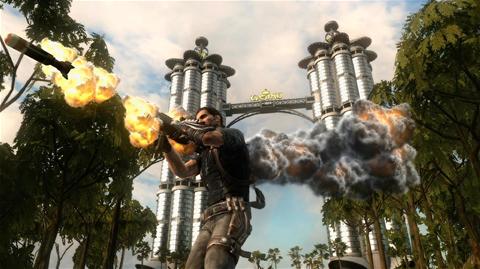
Remember the days when games were about gameplay, shooting enemies in a frenzy of violence, achieving that fatality after a hard battle in Mortal Kombat and dismembering hordes of zombies with a chainsaw. Avalanche Studios and Eidos the developers behind the original Just Cause have recognised this long hallowed tradition and came to the table with Just Cause 2. It’s a brutal departure from the mundane experience of the first game with high-octane stunts and gravity defying physics. From the outset, it is made clear the game isn’t focused on plot. Rather, gameplay is king and Just Cause 2 marries Chuck Norris fighting technique with the execution of a James Bond film. Shooting itself up with a few injections of adrenaline like jumping face first out of a plane at high altitude. Just Cause 2 is both a pleasure and an irritation.


The game’s storyline resembles a B-grade action movie and appears at first glance to be the oh-so predictable espionage tale of intrigue and big explosions. Just Cause 2 is set in the expansive South-East Asian island of Panau which is run in a similar vein to Cold War era Cuba, mixed with a bit of North Korean flair. You play as Rico Rodriquez an agent working for the shadowy US organisation “the Agency” and your mission is to eliminate the fascist regime of Baby Panay. The game follows the typical route of many of its sandbox predecessors, where players have a huge world map to explore (in the case of Just Cause 2 it’s epicly huge) and complete various missions. These missions are plentiful and the game itself works on the basis that the player needs to create chaos in order to increase the mission roster. With the insane arsenal of upgradeable weapons for purchase, not to mention vehicles, achieving chaotic bliss is no difficult chore and once you amass enough chaos various missions become available. Missions are divided between faction missions and agency missions, but first you have to choose one of the many factions.

Three main factions exist: the Roaches led by a corrupt businessman, the Reapers (definitely Che Guevara fans) and finally the Ular Boys led by a religious revolutionary reminiscent of the ever popular Osama Bin Laden. Faction missions follow the very simple formula of destroy, destroy, blow up stuff, destroy, save a hostage, destroy and destroy some more. The same can be said of the agency missions, which becomes repetitive as the game progresses. For the most part this is quite entertaining but can drag on after an intensely long gaming session. The reality is that Just Cause 2 is a game best played when either boredom sets in or time is not a factor. This doesn’t mean Just Cause 2 is a bad experience. Actually, it’s quite enjoyable and excessively fun until you have to travel from one side of the world map to the other searching for a mission trigger. In the game fighting increases the alertness of enemies (similar to wanted levels in GTA) and the more chaos you cause the higher the alert level. So be wary because if you’re alert level reaches critical you’ll be bombarded with missiles from every corner and the Panauan army will surface. But, if you have the skills you may survive, and fighting is at the heart of Just Cause 2’s game mechanic. The game is about duking it out with enemies and this is where the absurd charm of Just Cause 2 begins to shine.


Gameplay for the most part centers around a system relying on Rico’s dual grappling hook and his never-ending supply of parachutes. Pair this with a barrage of upgradeable weaponry and vehicles obtainable by gathering ‘parts’ and you become a lethal combination that leaves enemies incapacitated. The player can find a million ways to kill enemies, employing only the dynamics of the grappling hook and surrounding environment. In my own dabbling in-game I found attaching enemies to burstable gasoline cylinders quite enjoyable, with the enemy shooting straight up into the atmosphere hurtling. The absurdity of the gameplay is taken to new heights in some of the missions. One mission involves the player having to destroy a rocket midair whilst flying a jet at break speed where death greets you at the slightest error. Just Cause 2 is really over-the-top and is enjoyable in short bursts and in the end the gameplay means the player can be as creative as they want. But, one of the main problems with the game is the mission roster which is infinite and in my opinion wasteful of playing time. Where the game could be more dynamic by varying mission types, it ends up repeating the same missions with different scenery. This again is why I suggest you don’t solely dedicate gaming time to Just Cause 2, because I see it more as a ‘filler’ between other games.


The extensive world map is relentless and completing the game fully is a quest in itself. There are quite a few villages and cities scattered across the terrain begging to be freed and players can let loose enjoying the pure mayhem, still after prolonged play this too becomes tiring. Ultimately Just Cause 2 is a game you’d play for the sake of gameplay and is really exciting while it lasts, but dries out soon enough. Some would argue that the storyline is where the game falters but I thoroughly enjoyed the camp-ness of it all ( the terrible voice acting included). It really brought out the cheesiness of those old spy films the game is mirroring. Most would overlook this title because of dated graphics, which I might add are not really an issue on the PC, whereas on the XBOX 360 version the quality of the graphics is supposedly abysmal.

Yet, what is concerning is that gamers nowadays are coaxed into games with high polygon counts and the gameplay mechanics of a chimpanzee with a joystick (Dark Void anyone). Whereas, Just Cause 2 is a game dedicated to gameplay and shouldn’t be overlooked because of dated graphics. It sets out to be a fun explosive thrill and achieves that, but lacks storytelling depth and variety in missons which would otherwise make it an utter hit with the majority of gamers. Just Cause 2 is a hit and miss, with wasted potential. RAMjew